Laundry and care label symbols explained
Symbols checked against GINETEX's care symbols, October 2026
Contents:
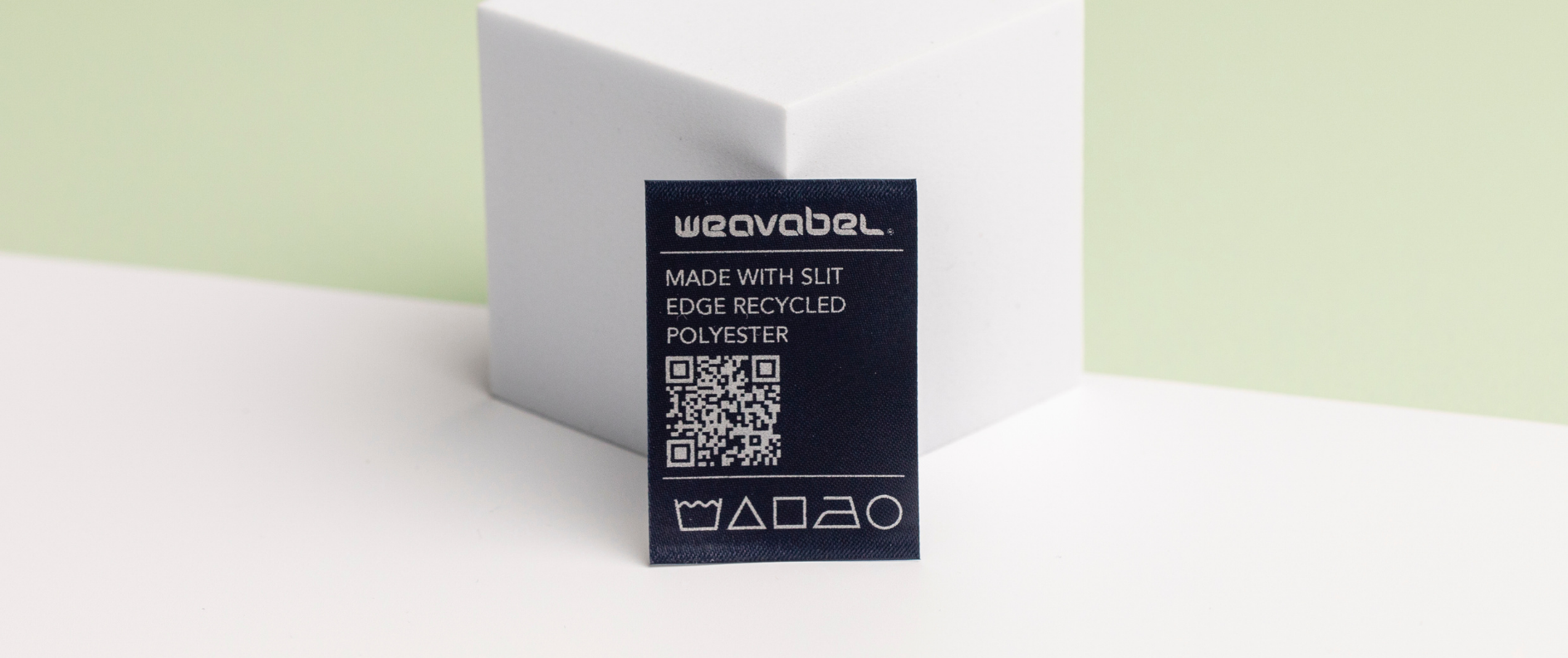
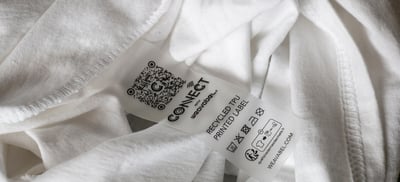
Look at the care label inside a wool jumper and you'll usually find a row of five small pictures. These are care label symbols, also called laundry symbols. They show how to wash, bleach, dry, iron and professionally clean a piece of clothing.
Every symbol starts from one of five shapes. A washtub covers washing and a triangle covers bleaching. A square means drying, an iron means ironing and a circle means professional cleaning.
It's the small marks on each shape that add the finer detail, and can sometimes trip people up. On that jumper, two bars under the washtub ask for a very mild wash, the kind used for machine-washable wool. A circle inside the square means tumble drying, so a cross through it rules the dryer out. The two dots on the iron mean you shouldn't iron hotter than 160°C (320°F).
Plenty of charts online still say the one-dot iron is 110°C (230°F). GINETEX, the association behind the symbols, gives 120°C (248°F).
We go through every symbol, shape by shape, with GINETEX's current temperatures, to help make sure your favourite garments get washed properly.
Care label symbols at a glance
Washing label symbols follow a set order on UK and European labels, from washing through to professional care. The table uses the same order, so it doubles as a quick laundry symbols chart you can check against the label in your hand.
|
Symbol group
|
Shape
|
What the marks tell you
|
|
Washing
|
Washtub
|
The number is the highest water temperature in °C. Bars underneath mean a gentler cycle. A hand means hand wash. A cross means do not wash.
|
|
Bleaching
|
Triangle
|
An empty triangle allows any bleach. Two diagonal lines inside allow oxygen bleach only. A cross means do not bleach.
|
|
Drying
|
Square
|
A circle inside means tumble drying, with dots for the heat. Lines inside mean drying without a machine, hung up or laid flat. A second line means drip drying, and a slanted line in the corner means dry in the shade. A cross through the circle means do not tumble dry.
|
|
Ironing
|
Iron
|
Dots set the highest temperature, from one dot (low) to three (hot). Crossed-out steam lines underneath mean no steam. A cross through the iron means do not iron.
|
|
Professional care
|
Circle
|
P and F mark types of dry cleaning, and W marks professional wet cleaning. A bar underneath means a gentler process. A cross means do not dry clean, or no wet cleaning when it's through the W.
|
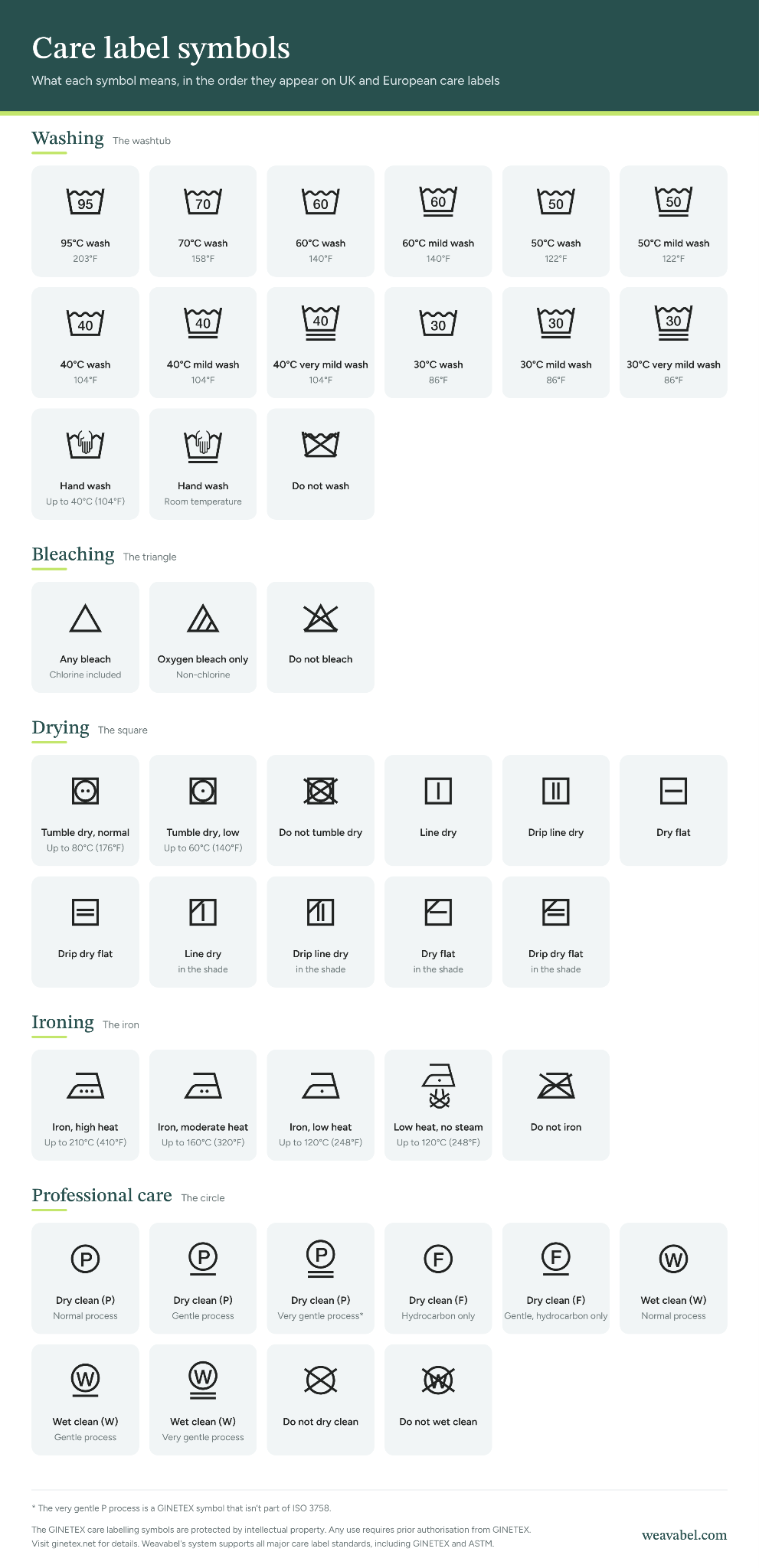
The GINETEX care labelling symbols are protected by intellectual property. Any use requires prior authorisation from GINETEX. Visit ginetex.net for details. Weavabel's system supports all major care label standards, including GINETEX and ASTM.
Washing symbols
The washtub covers both machine washing and hand washing, and it comes first on the label.
The number inside the tub is the highest water temperature in degrees Celsius. It runs from a cool 30°C (86°F) up to a 95°C (203°F) boil wash, with 40°C (104°F), 60°C (140°F) and 70°C (158°F) in between. ISO 3758 also includes a 50°C (122°F) wash, which you'll see on some labels. GINETEX matches the main settings to fabrics like this:
Bars under the tub ask the machine to go easy. One bar means a milder cycle with less movement in the drum, which suits polyester and more delicate fabrics such as viscose. Two bars mean a very mild cycle. On a 40°C very mild wash, GINETEX suggests filling the drum only a third full.
A hand in the tub means hand wash only, in water no hotter than 40°C. In 2023, the international standard for care symbols (ISO 3758) added a second hand wash symbol for water at room temperature, around 20 to 30°C (68 to 86°F).
The crossed-out tub keeps an item out of the wash altogether. Some fabrics can't be washed in water at all, and some items are simply too big for a home washing machine.
Bleaching symbols
Bleaching has just three symbols, all built on a triangle. An empty triangle means any bleach is fine, chlorine included. Two diagonal lines inside narrow that down to oxygen bleach only.
The crossed-out triangle means do not bleach, and that includes the bleach in some detergents. Because universal detergents contain oxygen bleach, GINETEX advises switching to a bleach-free detergent for anything with this symbol.
Drying symbols
Every drying symbol starts with a square. The marks inside tell you whether clothes can go in the tumble dryer or need to dry without one.
A circle inside the square means the tumble dryer is fine, and the dots inside the circle set the heat.
If a label has no tumble dry symbol, GINETEX suggests checking the washing and ironing symbols instead. The gentler those are, the more care the clothes will need in a dryer.
Lines inside the square, with no circle, mean drying without a machine. Vertical lines mean hang it up. Horizontal lines mean lay it flat.
Drip drying means hanging or laying clothes out soaking wet, straight from the wash, without spinning them first.
A slanted line in the top-left corner of the square means dry it in the shade. That suits fabrics that aren't colourfast, such as silk.
Ironing symbols
The iron works like the tumble dry symbol, with more dots meaning more heat. The dots set the highest temperature for the soleplate, the flat metal base of the iron.
Some clothes shouldn't be steamed. The 2023 update to ISO 3758 added a one-dot iron with a crossed-out steam symbol underneath, which means low heat and no steam at all.
An iron with a cross through it means do not iron.
Dry cleaning and professional care symbols
The circle is the one symbol written for someone else. It tells a dry cleaner or professional laundry how the clothes can be cleaned, and the letter inside names the method.
A bar under the circle asks for a gentler process, and two bars under the W ask for a very gentle one. A crossed-out circle means do not dry clean, and a crossed-out W means no professional wet cleaning.
How UK washing symbols differ from US care labels
Buy clothes from a US brand and the care label might not look quite like the ones you're used to. UK labels follow GINETEX and ISO 3758, as labels do across Europe. US labels follow a separate American standard, ASTM D5489, under the Federal Trade Commission's Care Labeling Rule.
The FTC describes the two sets of symbols as similar, though not identical. Do not bleach is a good example. A UK label crosses out an empty triangle. The US version fills the triangle in solid black.
Some US labels skip the symbols altogether. They're optional, as long as the care instructions are written out in words, so you might find a line of text where you'd expect a row of pictures. Either way, all clothing sold in the US has to say how to wash or dry clean it.
Frequently asked questions
How do you read care label symbols?
Start with the shape, then read the marks. The shape tells you the step, from washing through to professional care, and the numbers, dots and bars tell you how hot or how gentle to go. A cross through any shape means do not.
How should you dry clothes that say do not tumble dry?
Keep them out of the dryer altogether. GINETEX describes these clothes as unsuitable for tumble drying on any setting. Check the label for a line or flat drying symbol, which tells you whether to hang them up or lay them flat.
Should you set the iron by the care label or the fabric type?
Go by the care label. GINETEX says to choose the highest ironing temperature from the care label alone, and to take extra care with raised patterns or sewn-on decoration. If a cotton shirt's label shows two dots, use two dots, even though cotton usually gets three.
Behind every care label is a brand team that chose the symbols and put them in the right order. If that's you, our guide to branded care labels covers the licensing and layout rules. You can also browse our custom care labels or speak to our team about your next collection.
 Brochure
 Existing customers